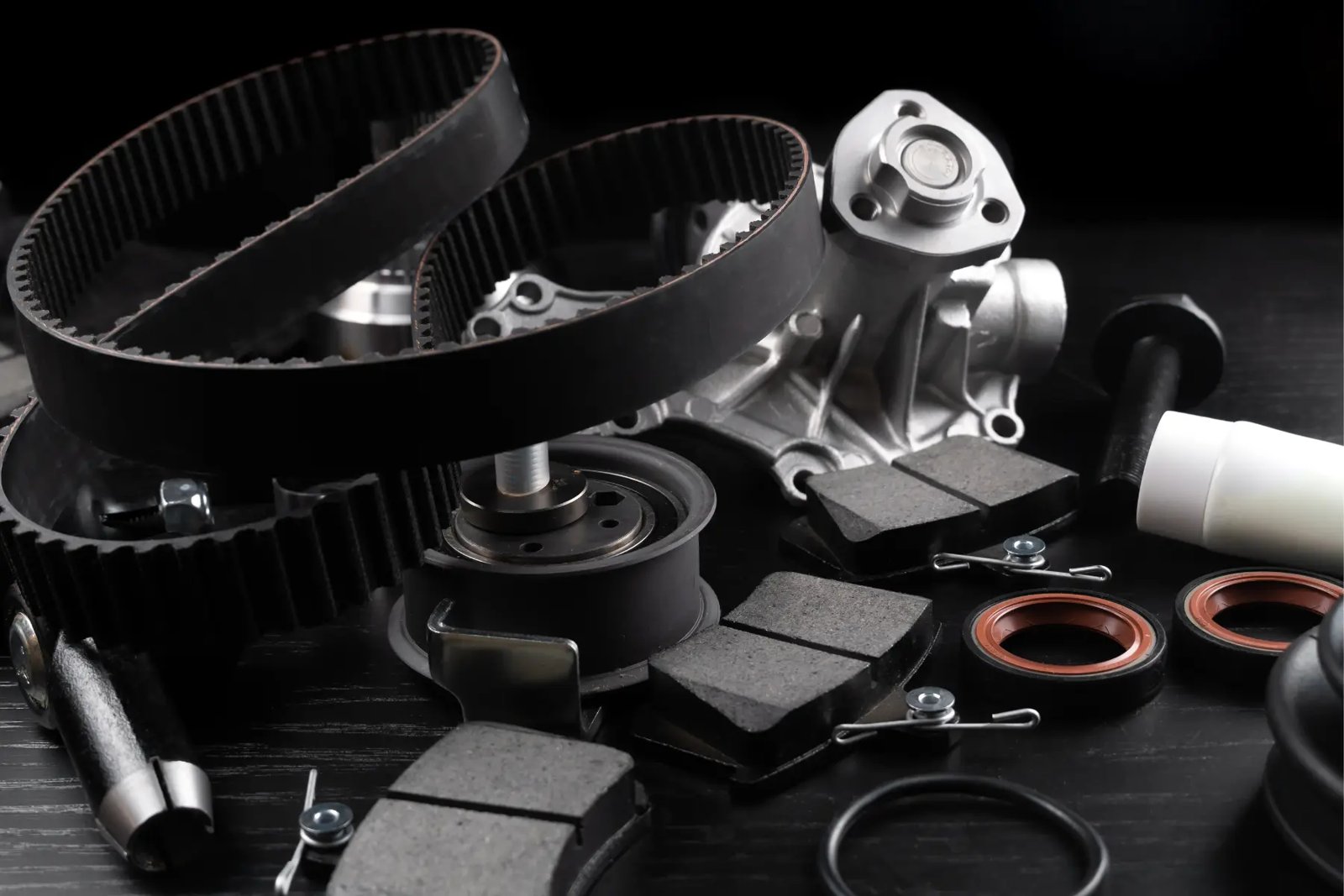
Timing belt
- Port of dispatchChina
- Estimate pricing$ 1 – $ 100Est. category range
- AvailabilityIn stock
- Type/ModelSynchronous rubber timing belt
- MaterialChloroprene rubber (CR), fiber-glass cord, elastic nylon fabric
- Color/FinishBlack rubber with green fiber-glass cords visible at edges
- CustomizationCustom tooth profiles, lengths, widths, and material grades available
Products Description
Timing belt The synchronous rubber belt is made of three materials: chloroprene rubber fiber-glass cord and elastic nylon cloth. The rubber synchronous driving band is a special kind of rubber driving belt to transmit the mechanical driving force. It transfers the driving force by its gearing with the gear wheel, gathering the characters of the gear wheel transmission , chain transmission and belt transmission. Rubber synchronous driving band transmission has the following advantages: It ensures a slip-free transmission between driving and driven wheels. The transmission speed ratio can reach 10 and the transmission speed, 40m/s. The transmission power can range from several watts to a hundred or so watts. Simple transmission mechanism, light weighted and lubrification not speed. Large initial tensile force not need and the spindle loab is small. Less noise while running. Easy for maintenance and replacement with new one. So it is widely used in the automobiles, chemical fibre and textile machines, cigarette making machines, printing machines, chemical and lighten industrial machines, mining, metallurgic and steel, plant machinery, office equipment, communication equipment, medical equipment, and various precision machine tools and instruments 50x30x20
Product Categories
Products Specification
- Type/ModelSynchronous rubber timing belt
- MaterialChloroprene rubber (CR), fiber-glass cord, elastic nylon fabric
- Key DimensionsConfirm with supplier
- Color/FinishBlack rubber with green fiber-glass cords visible at edges
- CustomizationCustom tooth profiles, lengths, widths, and material grades available
- PackagingBulk rolls or pre-cut loops; carton or wooden crate depending on order size
- MOQ BasisMOQ per order, varies by length/width; confirm with supplier
- CertificationsAsk the supplier
- Country of OriginChina
- HS CodeConfirm with supplier
- Temperature RangeOperation: -20°C to +100°C; Peak (intermittent): +120°C
- Tensile StrengthConfirm with supplier
- Elongation at Break≤ 2%

Basic member

Sino-Germany Joint Venture Ningbo Gul TZ Rubber Belt Co., Ltd
 China
China
(5.0)
Business type - Contact Seller
Inquire now
Related Products



Post your requirement – Global Trade Plaza
More Timing belt from Category








Timing belt from other sellers


Buy Online Wholesale Timing belt from Supplier & Exporter in China
The synchronous rubber timing belt is engineered for precise power transmission in industrial machinery, combining the reliability of gear drives with the smoothness of traditional belts. Its unique construction uses chloroprene rubber, fiber-glass cords, and an elastic nylon fabric layer to deliver high torque without slippage. Ideal for applications requiring synchronized motion such as CNC machines, automotive engines, or conveyor systems.
Manufactured by a Sino-Germany joint venture with over a decade of experience, this timing belt is designed for durability under continuous load and resistance to oils, heat, and abrasion. Its tooth profile engages directly with pulleys, eliminating backlash and ensuring consistent speed ratios. Buyers benefit from stable supply chains and technical support from a factory that serves both domestic and international markets.
Suitable for OEMs, machine builders, and repair shops, this timing belt is a cost-effective solution when precision and longevity are priorities. It reduces maintenance needs compared to chain drives and outperforms standard V-belts in high-torque or high-speed scenarios. Confirm with supplier for compatibility with your specific pulley dimensions and operating conditions.
Import Wholesale Timing belt for Your Business Needs
Best Fit & Nearest Alternatives
Best suited for:
- CNC and CNC router systems
- Automotive engine timing systems
- Conveyor systems requiring synchronized motion
- Packaging and printing machinery
- Robotics and automated assembly lines
Not ideal for:
- Highly abrasive environments without protective covers
- Applications exceeding the belt’s temperature rating (>100°C continuous)
- Ultra-high vacuum or cleanroom environments unless specified
Compared to polyurethane timing belts, this chloroprene rubber version offers better heat and oil resistance but may have slightly lower tensile strength. For applications requiring FDA compliance, confirm with supplier for material grade options.
What Drives the Price
- Belt length and width (longer or wider belts require more material and reinforcement)
- Material grade (standard chloroprene vs. specialty compounds for extreme conditions)
- Custom tooth profiles or non-standard dimensions
- Packaging requirements (bulk vs. retail-ready)
- Certification needs (e.g., ISO, UL, or automotive-grade compliance)
Pricing scales with MOQ and volume tiers. For custom specifications or bulk orders, request a quote to receive tiered pricing. Discounts typically apply at 500+, 2,000+, and 5,000+ unit thresholds.
Lead Time, Shipping & Returns
- Lead time: Typical lead time is 25 - 40 calendar days from order confirmation, contingent on belt specifications and factory load. Confirm with supplier for expedited options during peak seasons.
- Shipping: Standard modes include sea freight (FCL/LCL), air freight, and express courier. Sea freight is most economical for large orders; air freight is used for urgent deliveries under 500 kg. Confirm with supplier for incoterms and DDP options to your location.
- Returns & defects: Defective belts may be returned within 14 days of delivery if the defect is confirmed by inspection. Buyers are responsible for return shipping costs unless the defect is manufacturing-related. Always inspect goods upon arrival and retain packaging until confirmation of quality.
Handling & Application Notes
- Store belts in a cool, dry environment away from direct sunlight and ozone sources to prevent premature aging.
- Avoid stretching or bending the belt over sharp edges during installation to prevent internal cord damage.
- Ensure pulley alignment is within ±0.2 mm to prevent uneven tooth wear and premature failure.
About Supplier
Sino-Germany joint venture with production facilities in Ningbo, China, specializing in rubber timing belts and synchronous drive systems since 2010. The company combines German engineering standards with local manufacturing efficiency to serve global clients in automotive, industrial automation, and material handling sectors.
Certified to ISO 9001:2015, the supplier maintains in-house R&D and testing labs to validate belt performance under simulated load conditions. They offer OEM support, including custom tooth profiles and material formulations tailored to specific applications. Technical documentation and CAD templates are available for integration into buyer designs.
Supplier Details for Timing belt
- Established - 12 Jun, 2025
- Business Type - Manufacturer
- Deals in Product Type - Industrial Belts & Power Transmission
- Country - China
Frequently Asked Questions (FAQs) on Timing belt
1. What is the expected service life of this timing belt under normal operating conditions?
Service life varies by application but typically ranges from 10,000 to 50,000 hours depending on load, speed, and environmental factors. Confirm with supplier for life-cycle testing data under your specific conditions.
2. Can this belt be used with aluminum or steel pulleys?
Yes, the belt is compatible with both aluminum and steel pulleys. However, ensure the pulley material and hardness meet the supplier’s recommendations to avoid premature wear on the belt teeth.
3. Is this belt resistant to oil and grease?
The chloroprene rubber compound offers good resistance to oils, greases, and many chemicals. For prolonged exposure, confirm with supplier for material grade suitability and recommended cleaning intervals.
4. What is the maximum recommended belt speed for this product?
Typical maximum belt speed is 50 m/s, but this depends on belt width, load, and pulley diameter. Confirm with supplier for application-specific limits.
5. How should timing belts be stored to maximize shelf life?
Store in a cool, dry environment away from direct sunlight, ozone, and temperature extremes. Maintain a relative humidity below 65% and avoid contact with oils or solvents.
6. Do you offer belts with FDA-compliant materials?
Yes, FDA-compliant material grades are available for food processing and pharmaceutical applications. Confirm with supplier for certification documentation and suitability for your use case.
7. What is the standard tooth profile for this timing belt?
The standard tooth profile is trapezoidal (e.g., MXL, XL, L, H, or XH). Custom profiles are available upon request. Confirm with supplier for CAD files or templates.
8. Can the supplier provide CAD files or technical drawings for integration?
Yes, the supplier provides CAD files, 2D drawings, and technical specifications for integration into buyer designs. Request these during the quotation stage for seamless integration.
Explore Top Product Categories
- Alcohol Based Hand Sanitizer
- Paper Soap
- Antibacterial Hand Wash
- Cosmetic Kits
- Detergent Chemicals
- Industrial Chemicals
- Laboratory Chemicals
- Leather Chemicals
- Car Accessories
- Motorcycle Parts
- Automobile Brakes Spare Parts
- Motorcycle, Scooters & ATV Bikes
- Building Construction Machineries & Equipments
- Bricks
- Cupboards, Door, Gates, Grills & Windows
- Wall Tiles
- Filters, Water Treatment Plants
- Household Cleaning Products
- Wiping Rags, Mops, Dusters, Sponge, Brushes, Scourer
- Soap & Detergent
- Industrial Gears & Gear Boxes
- Machined Components
- Bolts
- Nuts
- Food Packaging Bags
- Wooden Packaging Boxes
- Offset Printing Machinery & Equipments
- Packaging Machinery
Related Products
V-beltTiming beltRaw edge cogged beltRibbed beltOffer spiral dryer beltsWebbing slingTiming beltIndustrial beltEP conveyor beltConveyor beltWincor ATM beltSeamless fusing M/C beltConveyor belt for rieter C60 card machineWebbing slingV belt / wrapped v beltWebbing slingEp conveyor beltRubber conveyor beltNylone conveyor beltPVC/PVG conveyor beltRubber v-beltFlat webbing slingRatchet tie downV-beltAluminium industry felt productWebbing slingDipped conveyor belt fabric
Related Categories
Industrial Belts & StrapsAbrasivesAnchorsBattery ScrapsBearingBoltsCement BagsClampsClipsDies & MouldingsFastenersFlangesGarbage BagsGasketsGlues & AdhesivesGrinding WheelHeat ExchangersHooks And LoopsHydraulic EquipmentsIndustrial BagsIndustrial BatteriesIndustrial Brakes & ClutchesIndustrial Chains, Anchor & HooksIndustrial ClothingIndustrial CompressorsIndustrial CouplingsIndustrial Cylinders